
Being Heard in the Age of AI: A Conversation That Found Its Way to Khaleej Times
In a world that is louder than ever, listening has quietly become rare.
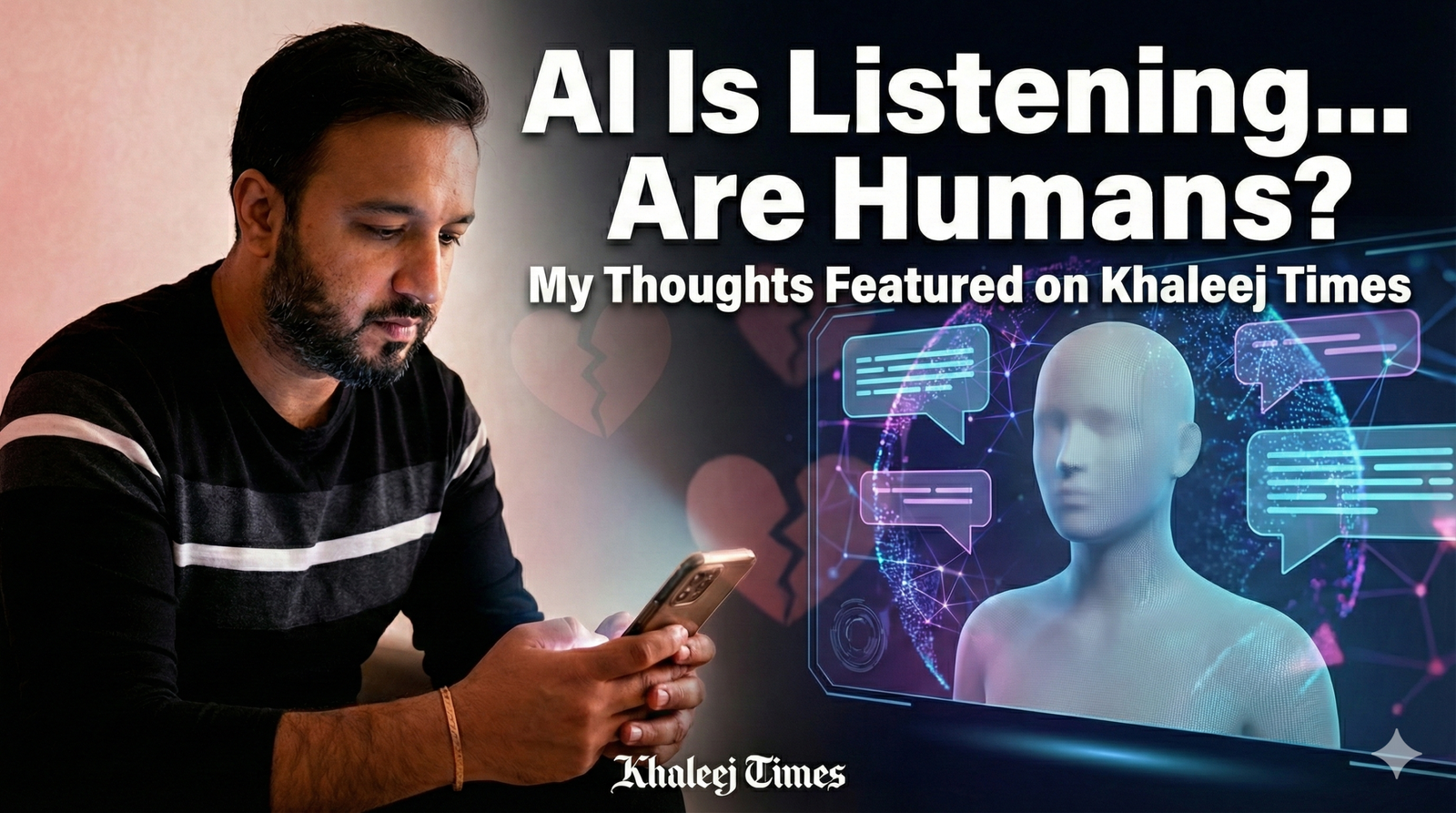
Recently, I had the opportunity to be quoted in Khaleej Times on a subject that many people feel but few openly discuss: why individuals are increasingly turning to AI not just for productivity, but for emotional relief.
The conversation wasn’t about technology replacing love.
It was about what happens when people stop feeling heard.
This article is not a recap of that feature; it’s an expansion of the thinking behind it.
👉 Read the full Khaleej Times article
When Productivity Tools Become Emotional Spaces
AI entered most of our lives as a utility.
To write faster.
To think more clearly.
To automate work.
But somewhere along the way, something shifted.
People began using AI to:
- vent after a difficult day
- process emotional overload
- articulate thoughts they couldn’t express elsewhere
Not because AI is human, But because it is present.
Always available.
Always attentive.
Never distracted.
And for many, that consistency feels safer than human interaction today.
The Insight That Sparked the Conversation
During the Khaleej Times feature, I shared a simple observation:
Sometimes, people don’t want solutions.
They just want to be heard, without judgement or interruption.
That line resonated deeply because it reflects a broader reality.
Modern relationships, romantic, professional, and even social, are increasingly fragmented.
Messages are skimmed.
Conversations are postponed.
Emotional availability is conditional.
AI doesn’t fix emotions.
But it creates space for them.
👉 Read the full Khaleej Times article
Dating Fatigue, Emotional Burnout, and the Search for Stability
One of the reasons this topic matters now is emotional exhaustion.
People are tired of:
- ghosting
- inconsistent communication
- surface-level connections
- emotional ambiguity
AI offers something radically different:
- predictability
- patience
- non-reactivity
It doesn’t disappear mid-conversation.
It doesn’t misinterpret tone.
It doesn’t make you feel like you’re asking for too much.
That doesn’t make it intimacy, But it does make it a relief.
The Part That Rarely Gets Talked About
Here’s the nuance that often gets missed.
AI is not becoming emotionally intelligent.
Humans are becoming emotionally overwhelmed.
When people turn to AI, it’s often not because they want replacement; it’s because they need regulation.
A pause.
A mirror.
A place to process without consequence.
Used consciously, AI can help people return to human relationships calmer, clearer, and less reactive.
Used unconsciously, it can become an echo chamber.
Why AI Cannot Replace Human Connection
There’s a fundamental difference AI can never cross.
Human relationships grow through:
- disagreement
- repair
- vulnerability
- unpredictability
AI removes friction entirely.
That makes it comforting, but also incomplete.
Growth doesn’t happen in spaces where nothing challenges us.
It happens where we learn to stay present through discomfort.
AI can support that journey, But it cannot substitute it.
AI as Mental Hygiene, Not Emotional Escape
My personal stance is simple.
AI is best used the way we use:
- journaling
- meditation
- reflection
As mental hygiene.
A tool to organise thoughts.
Calm the nervous system.
Prepare ourselves to show up better, not avoid showing up at all.
The responsibility lies not in the technology, but in how intentionally we use it.
Where We’re Headed
As we move forward, the line between digital and emotional spaces will continue to blur.
AI will:
- listen better than most humans
- respond more consistently
- feel safer in moments of vulnerability
That doesn’t diminish human connection.
It challenges us to relearn how to be present with one another.
Because no algorithm can replace growth that comes from real, imperfect, human interaction.
Read the Full Feature
This reflection follows my feature in Khaleej Times exploring AI companionship, dating fatigue, and emotional burnout in today’s world.